WORK FILE / OPEN
Prey for Me
Interactive and immersive performance, 2025
Presented at Magnet, Malmö, SE
DOCUMENTATION
Prey for Me is an interactive performance installation structured as a speculative therapeutic system. The work stages a clinic in which visitors undergo treatments designed to shift their perceptual and bodily state.
The experience begins in a waiting room, where participants complete forms addressing existential questions. These responses are used to assign individualized or collective “treatments.” The clinic operates as an interaction framework: a procedural system that translates language into embodied experience.

The treatment space takes the form of a constructed forest environment. Soil, nettles, thorns and stagnant water define the material conditions of the space, producing a tactile and potentially uncomfortable sensory field. Both performers and participants wear animal masks, dissolving stable distinctions between observer and subject.
Visitors are given a performative score that regulates behaviour within the environment. Verbal communication is suspended. Participants are permitted to rest, observe, approach or withdraw according to their own impulses. The system allows for non-linear, low-intensity forms of engagement, resisting expectations of progression, climax or resolution.


The treatments consist of loosely structured situations that oscillate between care, ritual and absurdity. These include collective resting, mutual washing, physical play and staged social rituals such as sharing a meal while performing civility from within an animal state. Through these actions, the work destabilizes normative behavioural codes and explores alternative modes of co-existence.
The project engages with a feminist critique of dominant narrative structures, particularly those organized around action, conflict and goal-oriented progression. Instead, it proposes a dramaturgy based on duration, presence and shifting states.
A central reference point in the development of the work is the observation of animal behaviour. The performative logic draws on patterns of instinct, rest, proximity and non-verbal communication, producing an environment in which human behaviour is reoriented through embodied rather than symbolic systems.

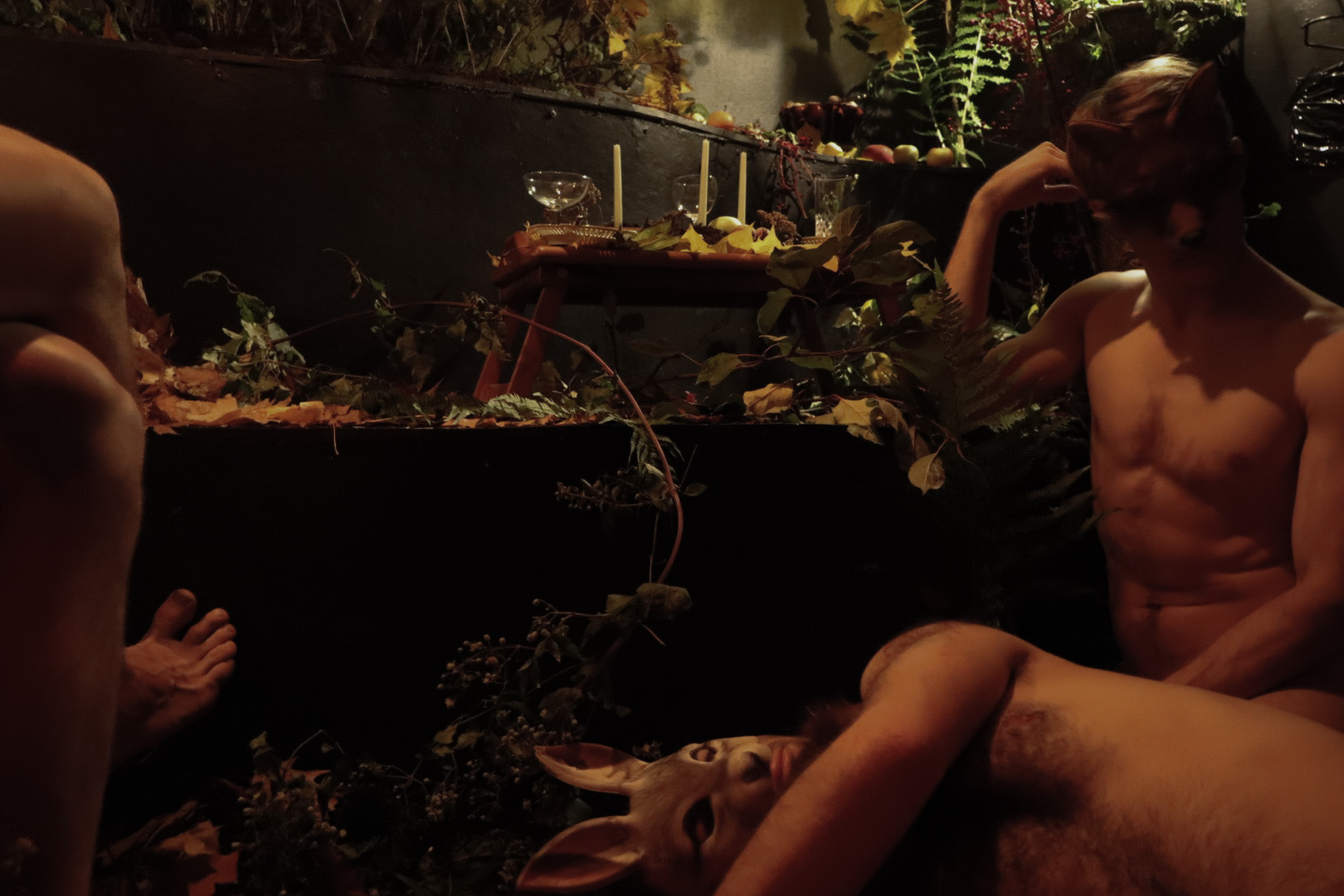
Conceptually, Prey for Me examines a collective cultural fantasy of “nature” as a site of liberation. This fantasy is approached as both seductive and problematic: a projection shaped by longing for escape from social structures, while simultaneously overlooking the violence, unpredictability and indifference inherent in natural systems.
The work addresses the tension between identification with nature and the persistent construction of the human as separate from it. Within this framework, the installation exposes the paradox of a subject that seeks to “return” to something it has never been outside of.
A theological subtext runs through the project. The longing for dissolution into nature is framed as a residual structure within a cultural memory shaped by the transition from pagan to Christian cosmologies. The work suggests the persistence of pre-Christian imaginaries within contemporary consciousness—an internalized call toward states of transformation, surrender and loss of individual form.
Through its interaction system and spatial dramaturgy,Prey for Me operates as a temporary environment in which participants negotiate different layers of human identity: social, animal, cultural and symbolic, without privileging a stable or unified position.